
As smart home adoption continues to grow in 2025, homeowners face an important choice: AV receiver vs soundbar for their entertainment hub. While both options provide unique benefits, the better fit depends on how you prioritize voice control, automation, and multiroom audio.
Therefore, in this guide, we compare AV receivers and soundbars across essential smart home factors — including assistant compatibility, ecosystem flexibility, and room-to-room expandability — to help you decide which solution suits your setup best.
Smart Home Features: AV Receiver vs Soundbar
When deciding between an AV receiver vs soundbar in 2025, smart home integration is often the deciding factor. Both deliver assistant support, streaming, and automation — but with different strengths.
AV Receiver
Voice Assistant Compatibility: Works with Alexa, Google Assistant, and Siri.
Multiroom Audio: Built-in with platforms like Yamaha MusicCast or Denon HEOS.
App Integration: Advanced apps allow zone control, EQ, and automation features.
Smart Home Routines: Seamlessly integrates with Alexa or Google routines.
Streaming Support: Full access to Spotify, TIDAL, Deezer, and more.
HDMI Support: eARC/ARC standard, often with multiple HDMI inputs for flexibility.
Smart Soundbar
Voice Assistant Compatibility: Native Alexa support, some models integrate with Siri via AirPlay 2.
Multiroom Audio: Platforms like Sonos, Bose, Samsung, and Yamaha offer whole-home sync.
App Integration: Simplified apps provide quick setup and control, though less advanced than receivers.
Smart Home Routines: Works well with Alexa routines for automation.
Streaming Support: Full access, depending on the brand ecosystem.
HDMI Support: eARC/ARC standard, usually limited to one HDMI input.
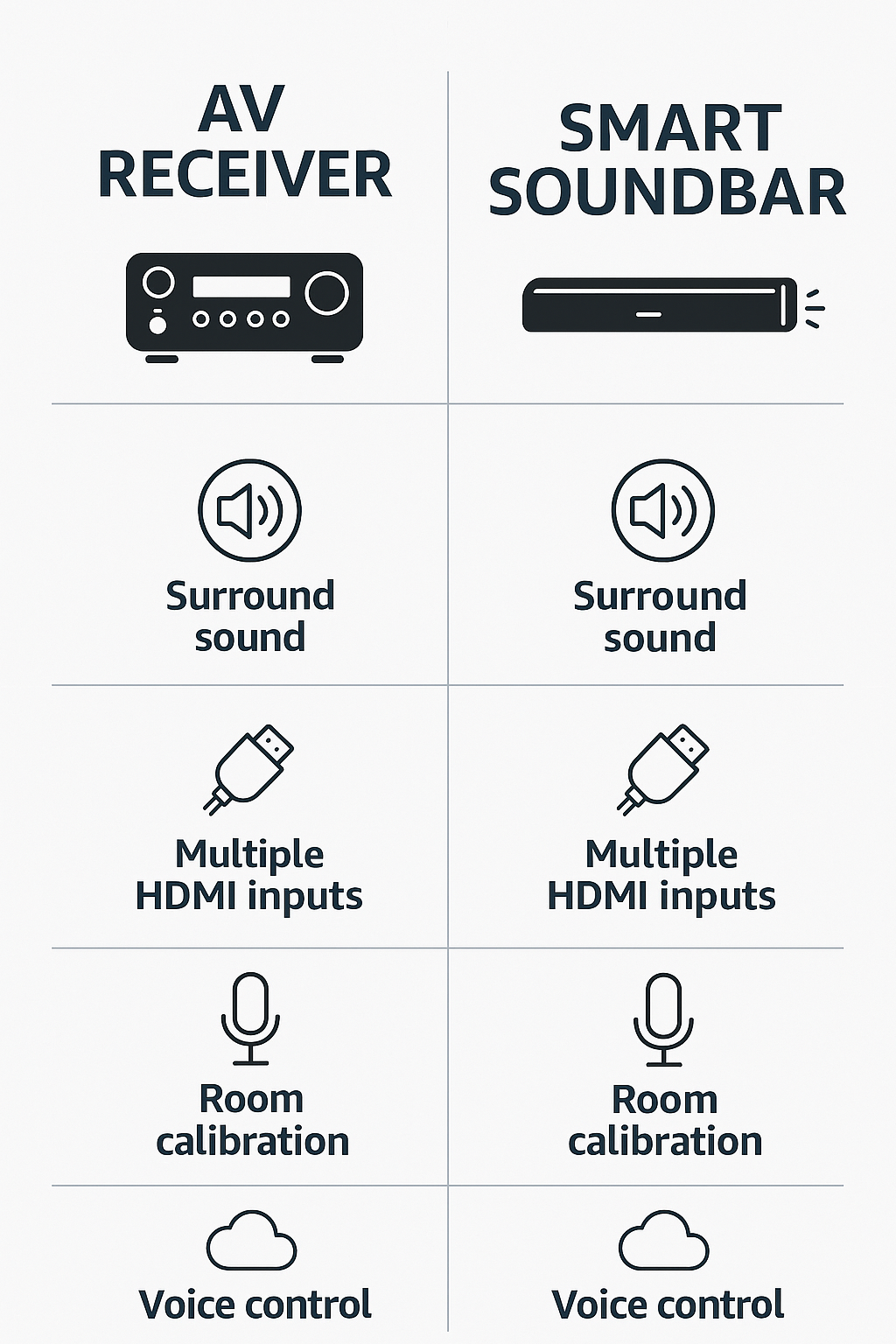
Pros & Cons: AV Receiver vs Soundbar
When weighing an AV receiver vs soundbar for a 2025 smart home, the decision comes down to complexity versus simplicity. Both offer clear strengths depending on your setup.
✅ AV Receivers – Advanced Smart Home Control
Deep assistant integration: Leading brands like Yamaha, Denon, and Marantz sync tightly with Alexa, Google Assistant, and Siri.
Scene control: Use apps like Alexa or SmartThings to create automated smart home routines.
Flexible zones: Manage grouped or individual speaker playback, ideal for multiroom or whole-home setups.
Pro Tip: Best for users who want complete customization and plan to scale their smart home audio system.
✅ Smart Soundbars – Simpler Smart Setup
Easy integration: Soundbars often include Alexa built-in, with options like the Sonos Beam Gen 2 or Bose Smart Soundbar 600.
Plug-and-play: Designed for quick setup, making them perfect for apartments or smaller living spaces.
Compact control: Fewer devices to manage, with single-app control for audio and smart features.
Pro Tip: Ideal for users who prefer straightforward voice control and space-saving design.
⚖️ Verdict:
Pick an AV receiver if you want advanced automation, multiroom expandability, and full ecosystem flexibility.
Choose a smart soundbar if you want the fastest path to Alexa integration and compact home theater audio.
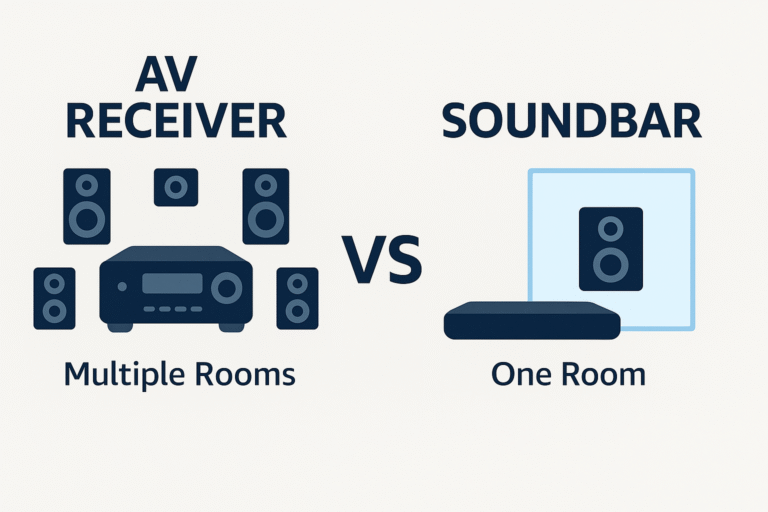
Buyer Scenarios: AV Receiver vs Soundbar
When choosing between an AV receiver vs soundbar in 2025, the right option depends heavily on your living space and audio goals. Here’s how each setup performs across common scenarios.
🛋 Living Room Theater Setup
AV Receiver: Provides true surround sound with formats like 5.1, 7.2, or Dolby Atmos, delivering a cinematic experience.
Soundbar: Offers simulated surround audio through virtual Atmos, usually in 3.1 or 5.1 configurations.
🛏 Apartment or Small Space
Soundbar: Best choice for easy installation and powerful audio in a single room.
AV Receiver: Often overkill unless paired with bookshelf or in-wall speakers to maximize space efficiency.
🔈 Multiroom Streaming Audio
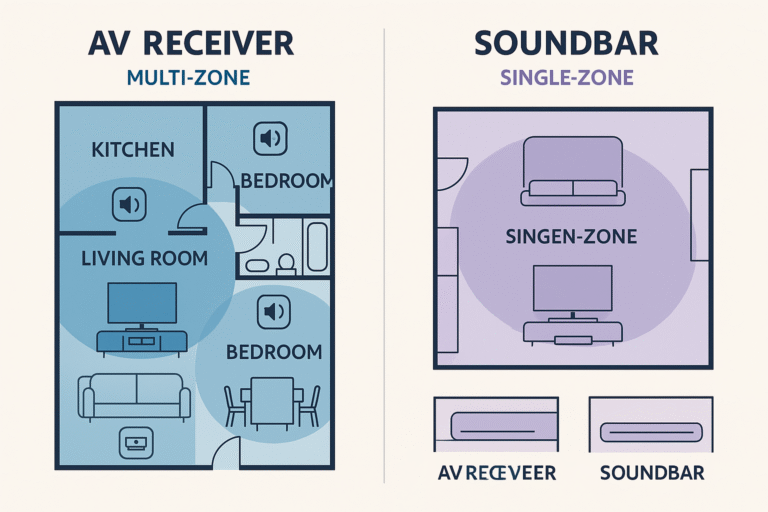
AV Receiver: Platforms like Yamaha MusicCast or Denon HEOS allow a receiver to act as a hub for multiple zones.
Soundbar: Systems like Sonos or Samsung can wirelessly link to additional speakers for multiroom playback.
Quick Scenario Comparison Table
| Scenario | Best Option | Reason |
|---|---|---|
| Living Room Theater | AV Receiver | True surround formats (5.1, 7.2, Atmos) |
| Apartment or Small Space | Soundbar | Easy install, compact design, great single-room audio |
| Multiroom Streaming Audio | Both | AV receiver for wired + multi-zone hubs, soundbar for wireless expansion |
✅ Verdict:
Choose an AV receiver for cinema-like surround and multi-zone control, while a soundbar shines in apartments and simple smart homes.
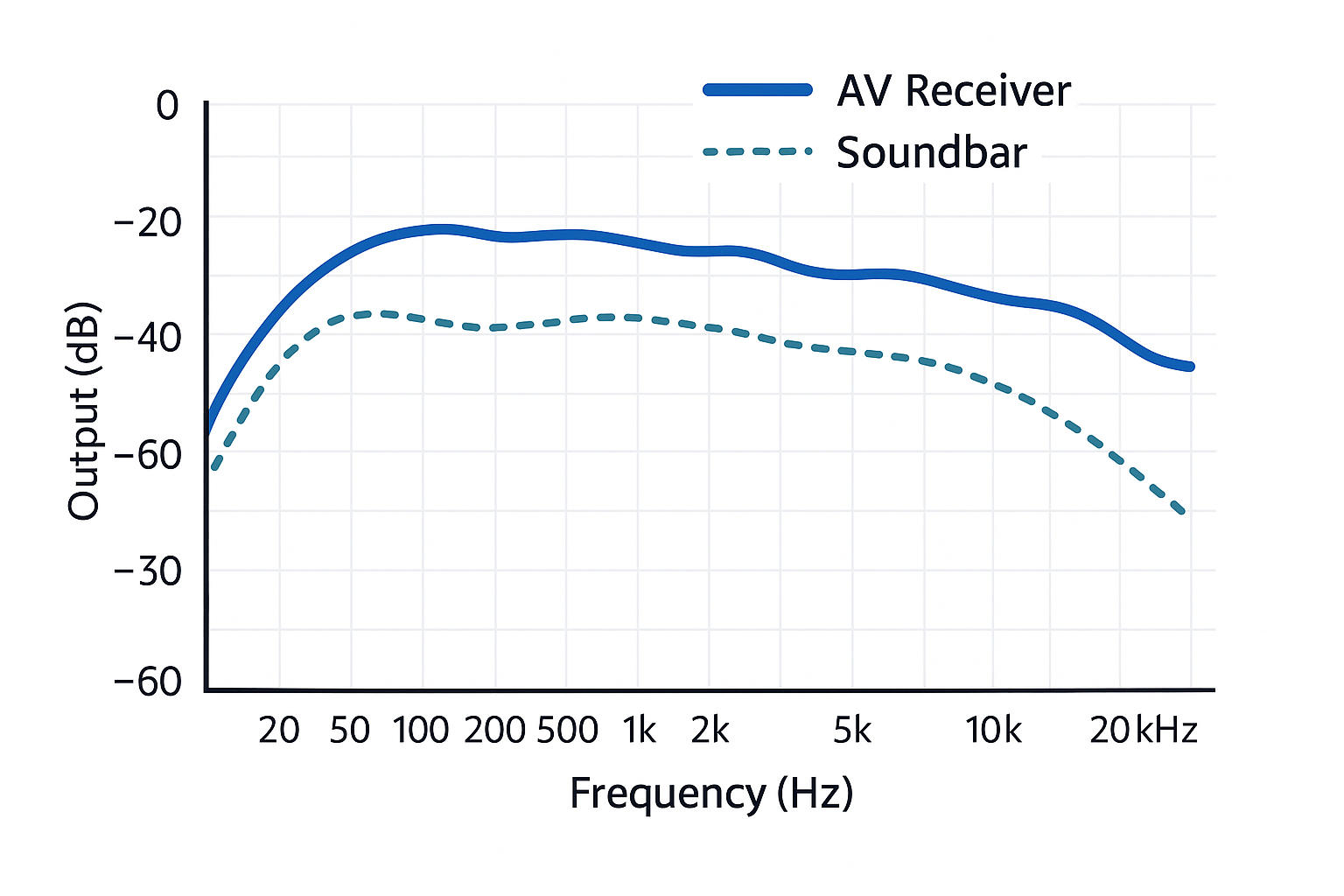
Performance & Audio Experience: AV Receiver vs Soundbar
When evaluating an AV receiver vs soundbar, performance often becomes the deciding factor. While both deliver quality audio, the difference lies in power, range, and complexity.
🎬 AV Receiver – Cinematic Power
More dynamic range, ideal for action movies, concerts, and gaming.
Better for large rooms, delivering true cinema-like sound across wide spaces.
Customizable speaker configuration (5.1, 7.2, Atmos) for tailored surround experiences.
Pro Tip: Choose if you want the closest home experience to a theater setup.
📺 Smart Soundbar – Everyday Simplicity
Improved dialogue clarity, perfect for casual TV and streaming shows.
Less complex setup, requiring fewer cables and no external amplifiers.
Compact design but lacks the raw power and expansive soundstage of a receiver-based system.
Pro Tip: Pick if you value simplicity and space-saving design over full cinematic immersion.
⚖️ Verdict:
Go with an AV receiver if you want maximum impact and theater-quality sound in larger rooms.
Choose a soundbar if you want clear dialogue and hassle-free setup in smaller living spaces.
Smart Home Control & Automation: AV Receiver vs Soundbar
Smart home integration is now a core factor when choosing between an AV receiver vs soundbar in 2025. Both offer Alexa support, but their approach differs in depth and convenience.
🎬 AV Receiver – Advanced Scene Control
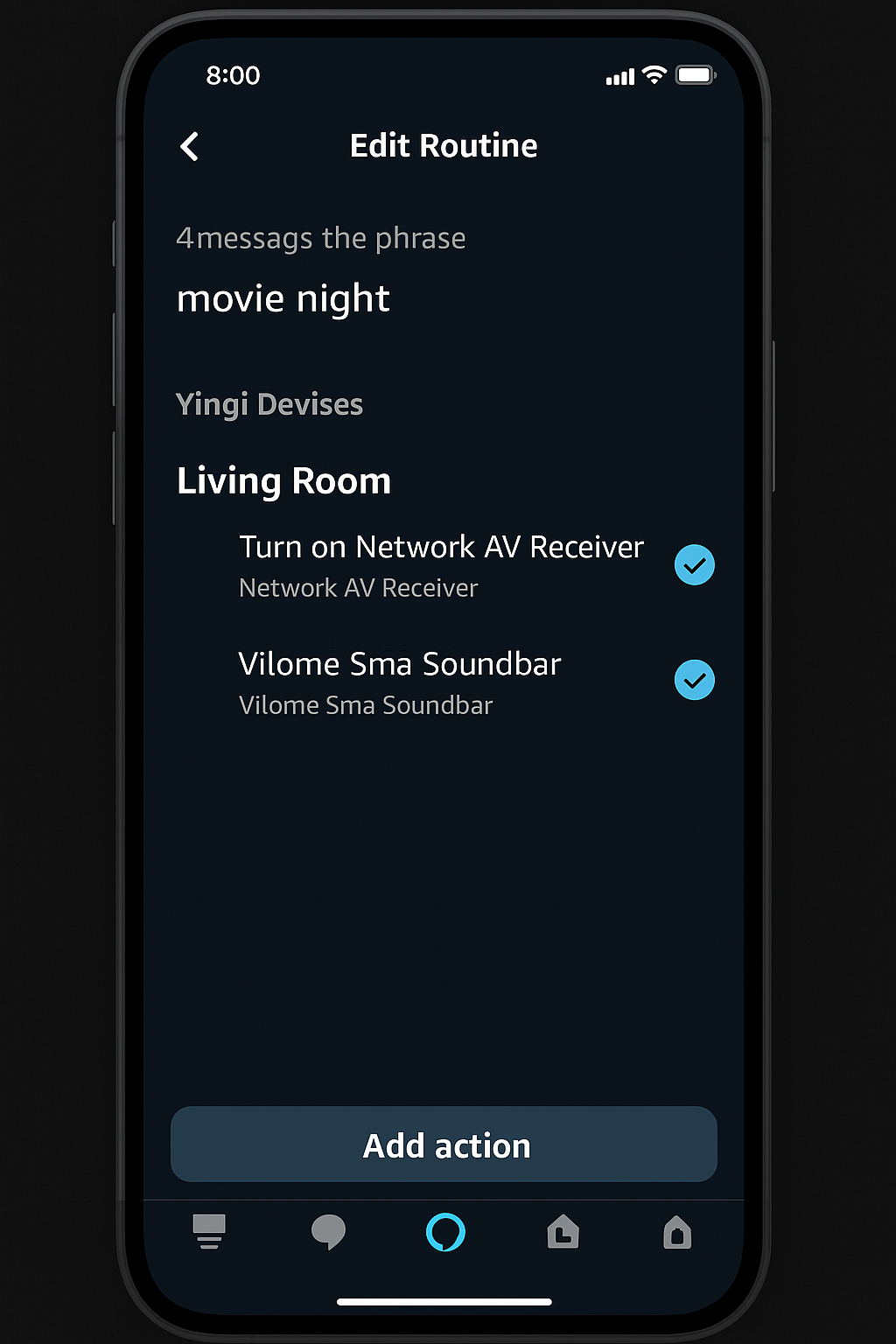
Pairs seamlessly with Alexa routines. Example: “Start movie night” can power on the receiver, switch inputs, and adjust smart lighting.
Provides advanced voice control for volume, input switching, and even multi-zone playback.
Works best for homeowners building a full smart home theater setup that ties into broader automation scenes.
📺 Smart Soundbar – Native Voice Simplicity
Many models feature Alexa built-in, with microphones that accept commands directly — no Echo Dot required.
Designed for single-room automation, such as: “Alexa, play music in the bedroom”.
Best suited for smaller spaces or apartments, where convenience and simplicity outweigh advanced control.
⚖️ Verdict:
Choose an AV receiver if you want deep smart scene control and automation across multiple devices.
Pick a smart soundbar if you prefer direct Alexa commands and quick, single-room setups.
Scenarios & Final Verdict: AV Receiver vs Soundbar
When comparing an AV receiver vs soundbar in 2025, your choice ultimately depends on space, budget, and long-term goals. Here’s a scenario-based breakdown.
Scenario Winners
| Scenario | Winner |
|---|---|
| Small apartment / condo setup | Smart Soundbar |
| High-end home theater + automation | AV Receiver |
| Multiroom music control | AV Receiver |
| Budget-friendly smart speaker setup | Smart Soundbar |
| Audiophile / music-focused home | AV Receiver |
🎯 Summary Recommendation
✅ Choose a smart soundbar if you want a compact design, easy Alexa integration, and minimal setup for one room.
✅ Choose an AV receiver if you’re planning a long-term home theater system or want to build a smart home with multi-zone audio and advanced automation scenes.
⚖️ Final Take: The best choice between an AV receiver vs soundbar comes down to simplicity versus scalability. A soundbar is ideal for quick smart home setups, while an AV receiver remains the gold standard for homeowners seeking true cinematic sound, advanced control, and future-proof expandability.