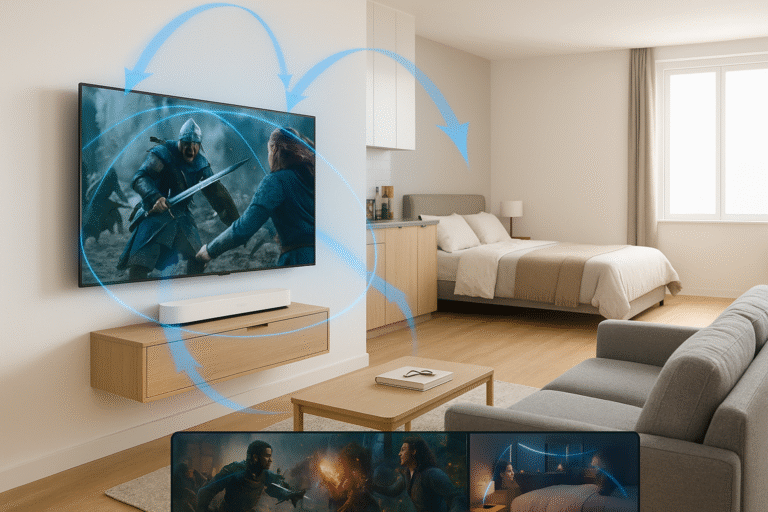

Dolby Atmos is no longer limited to high-end home theaters — it’s now available in compact soundbars like the Sonos Beam Gen 2, bringing immersive 3D sound into tighter spaces. But how effective is small room Dolby Atmos in real-world use? Can a compact soundbar truly create overhead depth in a 150-square-foot bedroom, or is it more of a marketing term than a meaningful upgrade?
In this guide, we’ll explore how Dolby Atmos technology works in smaller environments, how it adapts to acoustics and furniture placement, and whether the Beam Gen 2 delivers authentic spatial audio — or if saving your money for a larger system makes more sense.
What Is Dolby Atmos and How Does It Work?
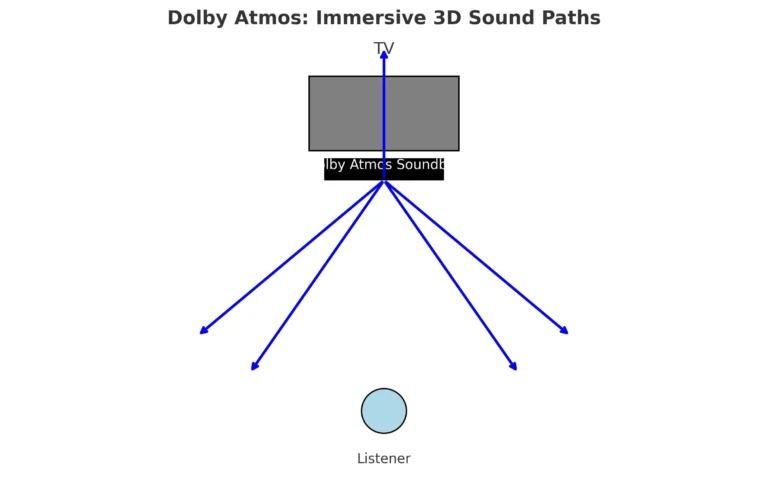
Unlike standard surround sound, Dolby Atmos adds a new level of immersion by introducing height channels. Instead of audio moving only from left to right or front to back, it now travels vertically — creating the sensation that sound flows above and around you. In compact environments, this makes small room Dolby Atmos especially impressive, as it transforms limited spaces into layered soundscapes.
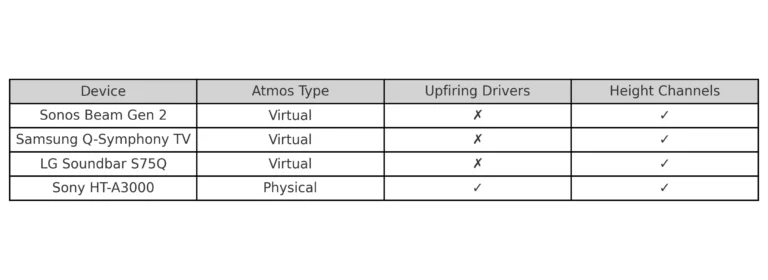
Traditionally, achieving this effect required upfiring or ceiling-mounted speakers, but modern soundbars like the Sonos Beam Gen 2 use advanced virtual processing to simulate those height effects. The result is a surprisingly spacious sound field — even without physical overhead drivers.
How Atmos Performs in Small Rooms
Interestingly, small room Dolby Atmos setups can actually enhance immersion rather than limit it. In compact spaces, sound reflections occur more quickly and precisely, allowing virtual height effects to feel more convincing. The shorter distances between walls and ceilings help Atmos processing create a denser, more enveloping sound field.
Key benefits of small room Dolby Atmos include:
Closer walls = faster sound reflections, improving directional accuracy.
Lower ceilings = stronger sense of vertical height, making overhead effects more realistic.
Compact acoustics = better control of reverb, allowing cleaner and more focused spatial rendering.
In essence, smaller rooms help Dolby Atmos virtualization perform at its best, delivering impressive 3D sound without requiring large, dedicated theater spaces.
How to Optimize Dolby Atmos in Small Rooms
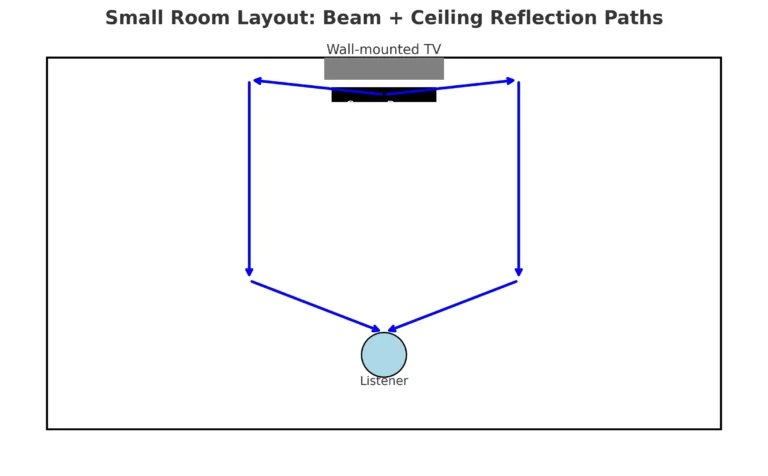
The Sonos Beam Gen 2 doesn’t rely on dedicated upward-firing drivers. Instead, it uses psychoacoustic processing — advanced algorithms that bounce sound off nearby surfaces to simulate overhead and surround effects. In small room Dolby Atmos setups, especially between 150–250 square feet, this approach can produce a surprisingly open and immersive soundstage.
Here’s what you can expect when it’s properly optimized:
More convincing overhead effects, as reflections reach the listener faster in smaller rooms.
Wider surround imaging, creating the illusion of multiple speakers from a single soundbar.
Best performance with flat ceilings between 7–9 feet, which reflect sound evenly for accurate spatial positioning.
By fine-tuning placement and ensuring minimal obstructions, small room Dolby Atmos systems like the Beam Gen 2 can deliver a cinematic experience that rivals much larger setups — all from a compact, easy-to-integrate soundbar.
Real-World Performance: How Dolby Atmos Feels Across Different Uses
| Use Case | Dolby Atmos Impact (Small Room) |
|---|---|
| Netflix Movies | Delivers clearer dialogue separation and distinct height cues, making scenes feel more cinematic. |
| Xbox / PS5 Gaming | Provides enhanced spatial awareness, letting you pinpoint sounds like footsteps or aircraft overhead. |
| Music with Atmos | Creates an expansive soundstage, even when playing standard stereo tracks, ideal for intimate listening spaces. |
| YouTube Videos | Shows minimal Atmos effect, since results depend heavily on the content’s audio mix. |
💡 Insight: In compact spaces, small room Dolby Atmos amplifies detail and directionality — giving everyday entertainment more realism without needing a full multi-speaker system.

Troubleshooting & Calibration Tips
To unlock the best results from your small room Dolby Atmos setup, proper placement and tuning are essential. Follow these quick adjustments to maximize clarity and spatial accuracy:
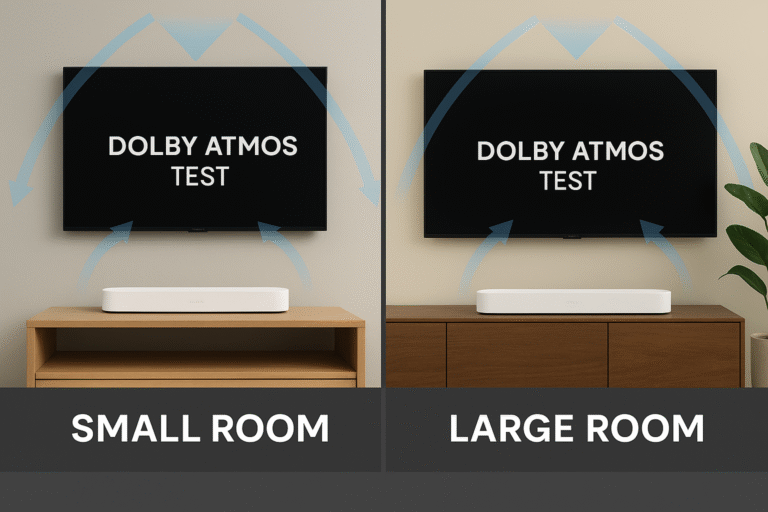
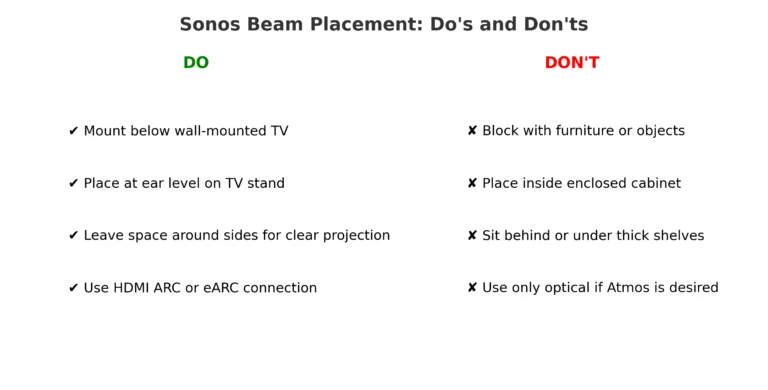
Position the Soundbar Correctly: Mount or place the soundbar 4–6 inches below your TV. This alignment ensures precise audio direction and helps Atmos reflections reach your ceiling effectively.
Run Trueplay Tuning: Use the Sonos app’s Trueplay feature to automatically adjust EQ for your room’s reflections. It fine-tunes the Beam Gen 2’s psychoacoustic processing to suit smaller spaces.
Maintain a Flat Ceiling: Keep your ceiling flat and unobstructed for the best vertical sound bounce. Avoid textured ceilings or heavy drapes near the front wall, as they absorb height cues.
Avoid Recessed Cabinets: Never place the Beam inside enclosed shelves or recessed TV stands, since doing so can trap sound and distort the Dolby Atmos effect.
With these small adjustments, your small room Dolby Atmos setup can deliver rich, multidimensional sound that feels far bigger than the space itself.
Virtual vs. Physical Atmos: Which Works Best in a Small Room?
| Feature | Virtual Atmos (Sonos Beam Gen 2) | Physical Up-Firing (Bose 600) |
|---|---|---|
| Ceiling Bounce Needed? | ✅ Yes — relies on reflections to simulate height effects. | ✅ Yes — uses dedicated drivers to project sound upward. |
| Speaker Count | Fewer speakers for a simpler, cleaner setup. | More drivers for traditional multi-channel output. |
| Small Room Effectiveness | ✅ High — reflections reach quickly, enhancing small room Dolby Atmos realism. | ✅ Moderate — requires more distance for proper sound dispersion. |
| Upgrade Potential | ✅ Expandable with Sonos One or Sub Mini for fuller surround sound. | ❌ Fixed configuration with limited expandability. |
💡 Takeaway: In compact spaces, virtual Atmos systems like the Sonos Beam Gen 2 often outperform physical up-firing designs. They take advantage of shorter reflection paths and room acoustics to deliver surprisingly rich small room Dolby Atmos performance — without the need for multiple speakers or complex calibration.
Is Dolby Atmos Worth It in a Small Room?
Yes — especially if you’re using a premium compact soundbar like the Sonos Beam Gen 2.
Even without physical up-firing drivers, the Beam’s virtual Atmos processing delivers a noticeable upgrade over standard stereo or 5.1 emulation.
In a small room Dolby Atmos setup, you can expect:
More immersive gaming and movie experiences, with sound that moves naturally around you.
Crisp height effects and accurate directional cues, giving a true sense of space.
Outstanding value, achieving cinematic immersion without clutter or extra speakers.
Ultimately, while it won’t replicate a full theater with ceiling speakers, small room Dolby Atmos from the Beam Gen 2 strikes the perfect balance between simplicity, performance, and affordability — making it one of the smartest upgrades for compact living spaces in 2025.