
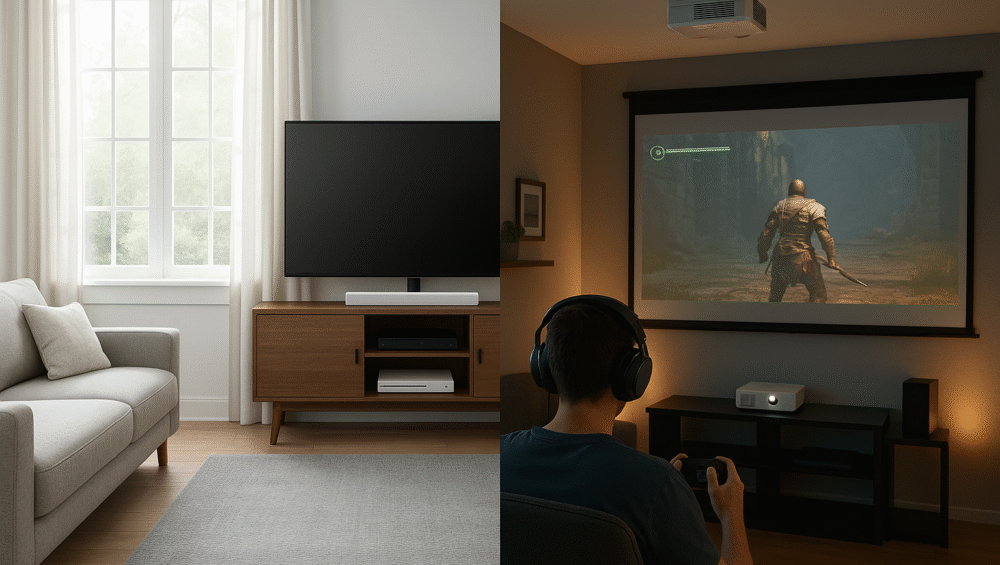
This head-to-head comparison takes a closer look at the HD146X vs HC880 projector, examining their performance, value, and everyday usability. By exploring the key differences between DLP and LCD technology, you’ll understand how each affects visual quality, gaming responsiveness, and setup flexibility. Ultimately, this guide helps you decide which projector—the Optoma HD146X or the Epson Home Cinema 880—is the best fit for your home theater or gaming setup.
DLP vs LCD: What’s the Difference?
To fully understand the HD146X vs HC880 projector comparison, it’s important to look at the core technology behind each model. Each brand’s approach offers unique advantages depending on your priorities—whether that’s gaming performance or vivid color accuracy.
DLP (Optoma): Utilizes micro-mirrors to project sharp, high-contrast images. This makes it ideal for fast-paced content such as gaming and action movies, where motion handling is critical.
LCD (Epson): Produces vibrant, true-to-life colors with higher brightness output, making it perfect for colorful films, sports, and presentations in well-lit rooms.

Feature Comparison – HD146X vs Home Cinema 880
Here’s a detailed breakdown comparing the HD146X vs HC880 projector, highlighting their core specifications and real-world differences. By examining their brightness, contrast, and gaming performance, you can determine which model best suits your entertainment setup.
| Feature | Optoma HD146X | Epson Home Cinema 880 |
|---|---|---|
| Projection Tech | DLP – delivers sharper contrast and smoother motion | 3LCD – offers more vibrant and natural colors |
| Resolution | 1080p Full HD | 1080p Full HD |
| Brightness | 3,600 lumens – ideal for mixed lighting conditions | 3,300 lumens – performs well in moderately lit rooms |
| Contrast Ratio | 500,000:1 – deeper blacks and higher detail in dark scenes | 16,000:1 – solid but less dynamic contrast |
| Input Lag | 16ms (Game Mode) – excellent for fast-paced gaming | ~25ms – acceptable for casual gaming |
| Lamp Life (Eco) | Up to 15,000 hours – lower maintenance | Up to 12,000 hours – slightly shorter lifespan |
| Keystone Correction | Vertical only – simple but limited adjustment | Horizontal & Vertical – more flexible placement options |
| Price (avg) | Around $550 | Around $599 |
In summary, the HD146X vs HC880 projector comparison shows that the Optoma HD146X favors gamers and contrast lovers, while the Epson HC880 is better for users who prioritize color accuracy and installation flexibility.

Gaming Showdown: Which Performs Better?
When comparing HD146X vs HC880 projector performance for gaming, the difference in responsiveness becomes clear. While both handle 1080p gameplay smoothly, the Optoma clearly caters more to serious gamers.
Optoma HD146X: Specifically designed with gamers in mind, it features an Enhanced Game Mode that cuts input lag to about 16ms, allowing for real-time control and fluid motion. Thanks to DLP technology, it also minimizes motion blur—making it ideal for competitive or fast-paced gaming.
Epson Home Cinema 880: Suitable for casual gaming, but with an input lag around 25ms, there’s a slight delay noticeable in reflex-based games. It performs well for story-driven or slower titles, though it’s less optimized for competitive play.

Movie and Streaming Performance: HD146X vs HC880 Projector
When evaluating HD146X vs HC880 projector performance for color and picture quality, each model shines in different environments. Depending on your viewing space, one may fit your setup better than the other.
Epson Home Cinema 880: Delivers vibrant, lifelike colors that truly stand out in animated films and nature documentaries. Its higher brightness makes it ideal for bright rooms and family viewing where ambient light can’t be fully controlled.
Optoma HD146X: Excels in darker environments, producing cinema-like contrast and deep black levels. This makes it perfect for movie nights or dedicated gaming rooms where immersion and shadow detail matter most.

Setup and Installation
When it comes to setup flexibility in the HD146X vs HC880 projector comparison, placement options can greatly influence your viewing experience. Each model offers distinct advantages depending on your room layout and mounting preference.
Optoma HD146X: Needs precise placement because of its limited keystone adjustment and narrow zoom range. It performs best when ceiling-mounted or placed on a stable shelf where alignment can be fixed for consistent image quality.
Epson Home Cinema 880: Offers greater flexibility with both horizontal and vertical keystone correction, making it easier to position in various room setups — ideal for apartments or multi-purpose spaces where projector placement may vary.

Energy Efficiency and Maintenance
In terms of maintenance and longevity, the HD146X vs HC880 projector comparison reveals subtle but important differences that affect long-term convenience.
Lamp Life: The Optoma HD146X has a slight edge, offering up to 15,000 hours in Eco Mode, which helps reduce replacement costs and maintenance frequency.
Filters: The Epson Home Cinema 880 uses air filters that need periodic cleaning or replacement, while the Optoma’s DLP technology is completely filter-free, making it a lower-maintenance option overall.

Which One Is Right for You?
When deciding between these two entry-level projectors, your ideal choice depends on how and where you plan to use it. Each model excels in specific scenarios, making the decision easier once you know your priorities.
Choose the Optoma HD146X if:
You’re a gamer seeking low input lag and smooth motion handling.
You prioritize contrast and deep blacks for dark-room viewing.
You prefer long lamp life and minimal maintenance, thanks to its filter-free DLP design.
Choose the Epson Home Cinema 880 if:
You value color accuracy for movies, animation, or presentations.
You often watch content in brighter rooms or shared spaces.
You need flexible projector placement, supported by both horizontal and vertical keystone correction.
In short, when comparing the HD146X vs HC880 projector, the Optoma HD146X is better suited for gamers and home theater enthusiasts, while the Epson HC880 caters to those who want vivid color performance and easier setup flexibility.

Final Verdict – HD146X vs HC880 Projector
Both models deliver excellent value, but your usage style and room environment will ultimately decide which one is right for you. In the HD146X vs HC880 projector comparison, each device brings unique strengths to the table.
The Optoma HD146X truly shines for gamers, offering low input lag, strong contrast, and smooth DLP motion—perfect for immersive, lag-free gameplay.
Meanwhile, the Epson Home Cinema 880 stands out in bright-room viewing, delivering vivid colors, flexible placement options, and family-friendly usability.
🏆 Winner for Gaming: Optoma HD146X
🎨 Winner for Color & Flexibility: Epson Home Cinema 880
